The summary could describe anyone
Phrases like "dedicated professional with strong communication skills" could sit on a thousand resumes. They don't point to your strengths for this job.
For experienced professionals who are actively applying
A practical, step-by-step system for turning a generic, task-focused resume into a focused, role-specific application, so an employer can more easily see why your experience fits the job. You also leave with a process you can repeat for every application after.
A digital guide and workbook toolkit, with two bonus tools that work alongside it.
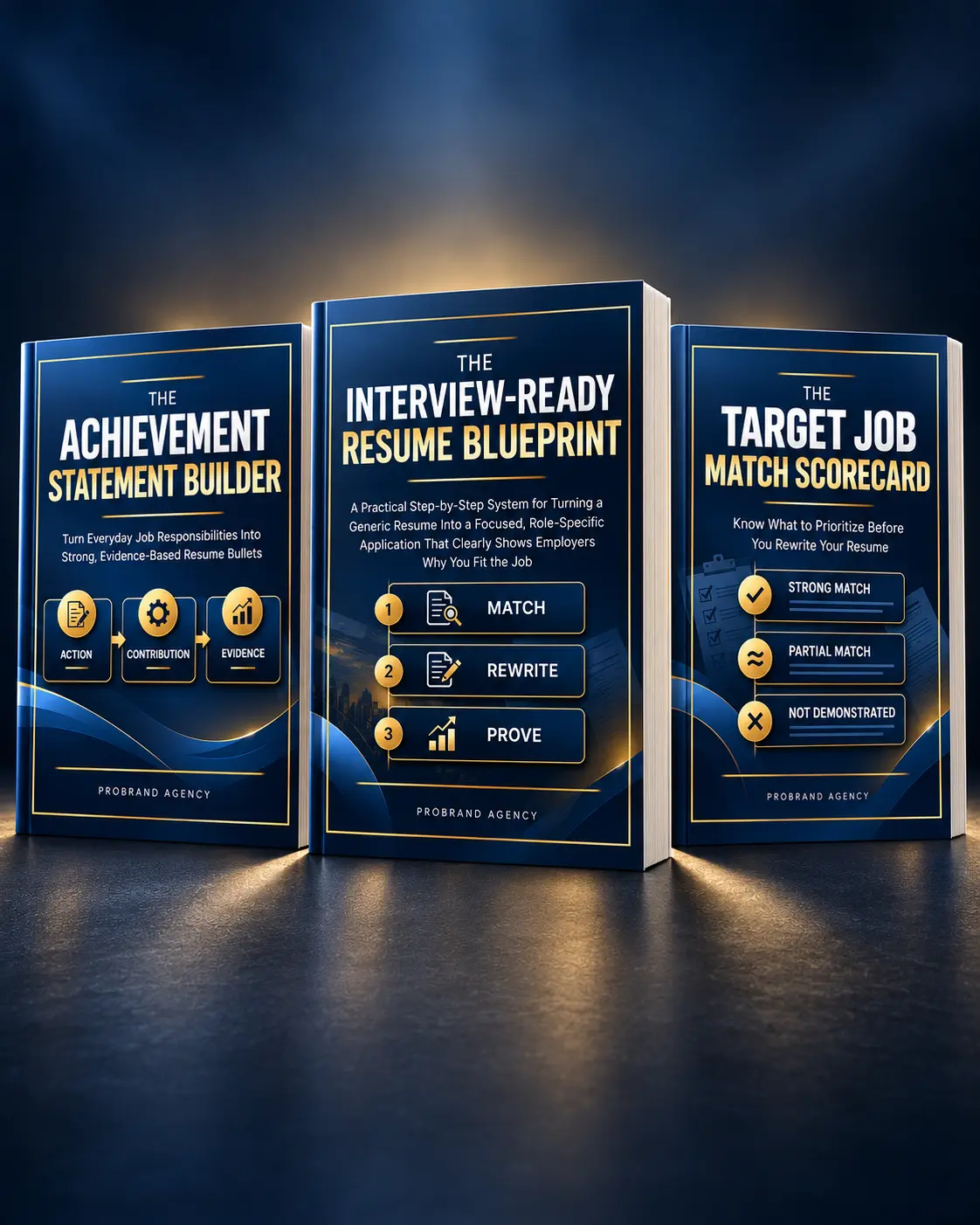
Your resume may be making the reader work too hard to see why your experience matters for this particular role.
Maybe you've been applying for a while and hearing very little back. It's easy to conclude the problem is your background. Often, it's something more fixable: how that background is communicated.
A resume that lists what you were responsible for leaves the reader to figure out what you actually contributed, which parts matter for this job, and why they should believe it. When the same general document goes to every employer, that work falls on someone who may be reading quickly.
That doesn't mean you lack anything. It means your most relevant experience may not be easy to recognize yet.
Hiring depends on many factors beyond a resume. But your resume is the part you can shape, and it can be shaped with a clear method.
This isn't for you if you want help inventing achievements, inflating titles, or claiming skills you don't have. Everything in the Blueprint is built around truthful representation.
Almost every experienced professional has a few of these. Spotting them is the first step to fixing them.
Phrases like "dedicated professional with strong communication skills" could sit on a thousand resumes. They don't point to your strengths for this job.
"Responsible for…" tells the reader what the role involved. It doesn't show what you did with it.
When the resume doesn't change from one posting to the next, the reader has to find the match themselves.
A long skills list with no sign of where or how you used each skill gives the reader little reason to take it seriously.
The experience most relevant to the role may be sitting halfway down page two, in the same weight as everything else.
Without a sense of size, setting, or who benefited, even strong work can read as small or vague.
If you recognized a few of these, that's common, and it's fixable.
What's true about your career and what a reader takes from a quick look at your resume can be two different things. The gap between them is a communication problem, not an experience problem.
You've led work that closely matches the job's most important requirement.
It appears as one short line, fourth in a list, under an older role.
You're good at solving problems and bringing people together.
A summary that says "results-oriented team player," with nothing to back it up.
You have the specific skill the employer is asking for.
It sits in a skills list, with no sign of where you used it or what came of it.
There's plenty of useful resume advice online, and you may have read a lot of it already. For most people, the hard part isn't finding tips. It's knowing which ones apply to this job, what order to work in, and what to do with your experience.
| Area | Disconnected tips and templates | A repeatable method |
|---|---|---|
| Where you start | A general list of things to do. | One real job description and your own real experience. |
| Your decisions | Left to you, with no clear order. | A sequence for deciding what to emphasize, reduce, reposition, strengthen, or remove. |
| Your claims | Often polished but general. | Supported with truthful evidence. |
| Next application | Start over and guess again. | Run the same process again. |
A template changes how a resume looks. It can't decide what your resume should say for a specific role. That decision is where most of the value sits, and it's what this Blueprint walks you through.
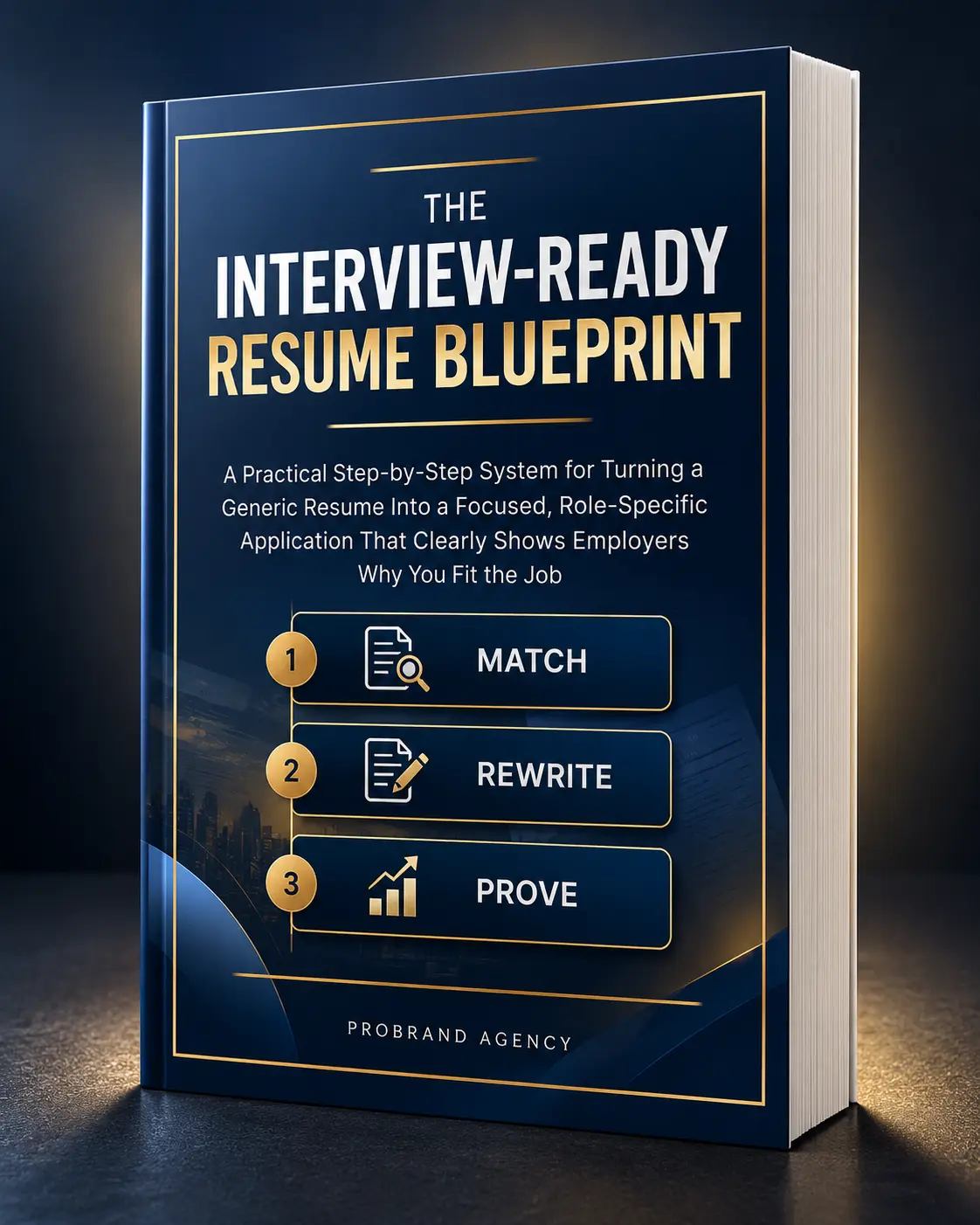
The solution
A Practical Step-by-Step System for Turning a Generic Resume Into a Focused, Role-Specific Application That Clearly Shows Employers Why You Fit the Job
The Blueprint is a digital career guide with a practical workbook and toolkit. You work through it with one real job in front of you and your own real experience beside it. Chapter by chapter, you diagnose what your resume is communicating now, decide what matters for the role, and rebuild it around truthful, specific evidence.
It doesn't hand you a template to fill in or words to borrow. It helps you make better decisions about your own material, and then gives you a process you can repeat.
The method inside
Three stages that work together. Each one fixes a different way a strong background can end up hidden on the page.
What does this employer need most?
Analyze one complete job description. Work out which requirements carry the most weight, then find where your real background connects to them. This isn't keyword stuffing. The strongest match is a clear link between an important requirement and credible experience.
Without it, relevant experience can stay buried.
How do I say it so the contribution shows?
Turn generic responsibilities into clearer statements of what you contributed. Decide what to emphasize, reduce, reposition, strengthen, or remove so the right things stand out for this role.
Without it, a strong match can stay buried in vague, duty-style wording.
What supports this claim?
Back your important statements with truthful evidence: results, examples, scope, scale, context, recognition, or other information you can stand behind. You never need to invent a number.
Without it, a polished statement can still sound vague.
Matching without rewriting can leave relevant experience buried.
Rewriting without proof can produce polished but vague statements.
Proof without matching can spotlight achievements that don't matter for the target role.
That's why the three stages are taught as one connected system.
An illustrative example only. The highlighted brackets are placeholders you would fill in with true information about your own work, and leave out anything you can't support.
"Responsible for monthly client reporting."
"Rebuilt the monthly reporting process for [number of accounts] so [who used it] could [what it made possible]. [Add a result, scope, or example only if you can support it.]"
Your first working session
You don't have to finish the whole guide before you see a difference on the page. In your first working session, you can:
Pick an actual posting you want to apply for, so everything you do has a specific job to point at.
Read the full description closely and identify the three priorities the employer is signaling most strongly.
Begin reorganizing what a reader sees first around those three priorities, using your real experience.
What's inside
The Blueprint is built as a progression, so you always know what to do next and why it comes before the step after it.
Each chapter combines short, practical teaching with exercises you complete using your own resume and your own target job.
Get set up with your target job and current resume, and see how the three stages fit together.
Look at your resume the way a reader would, and pinpoint where it's generic, unclear, or focused on tasks.
Analyze one job description, identify what matters most, and connect those priorities to credible experience.
Rework the part a reader sees first so it speaks directly to the priorities you identified.
Move from what the job involved to what you contributed, and decide what to emphasize, reduce, or remove.
Identify truthful support for your claims, including what to use when you don't have a hard number.
Assemble everything into one focused resume built around the job you chose.
Check your draft, fix common trouble spots, and learn how to run the process again for the next role.
Leave with a clear plan for your next applications and the steps you'll take to tailor each one.
This isn't a book to read and shelve. The exercises put the method to work on your own resume.
See what your current resume is actually communicating.
Review each section for what's helping and what's getting in the way.
Break a posting down and connect it to your real experience.
Decide what to emphasize, reduce, reposition, strengthen, or remove.
Shape everyday work into clear statements of contribution.
Find results, scope, scale, and context you can truthfully stand behind.
Check your finished resume against the job before you apply.
Turn the process into a plan for your next applications.
By the end, you'll have a clearer resume for a real job and a method to use again.
The Blueprint is designed to improve clarity, relevance, organization, targeting, and evidence in your resume. It does not guarantee interviews or employment.
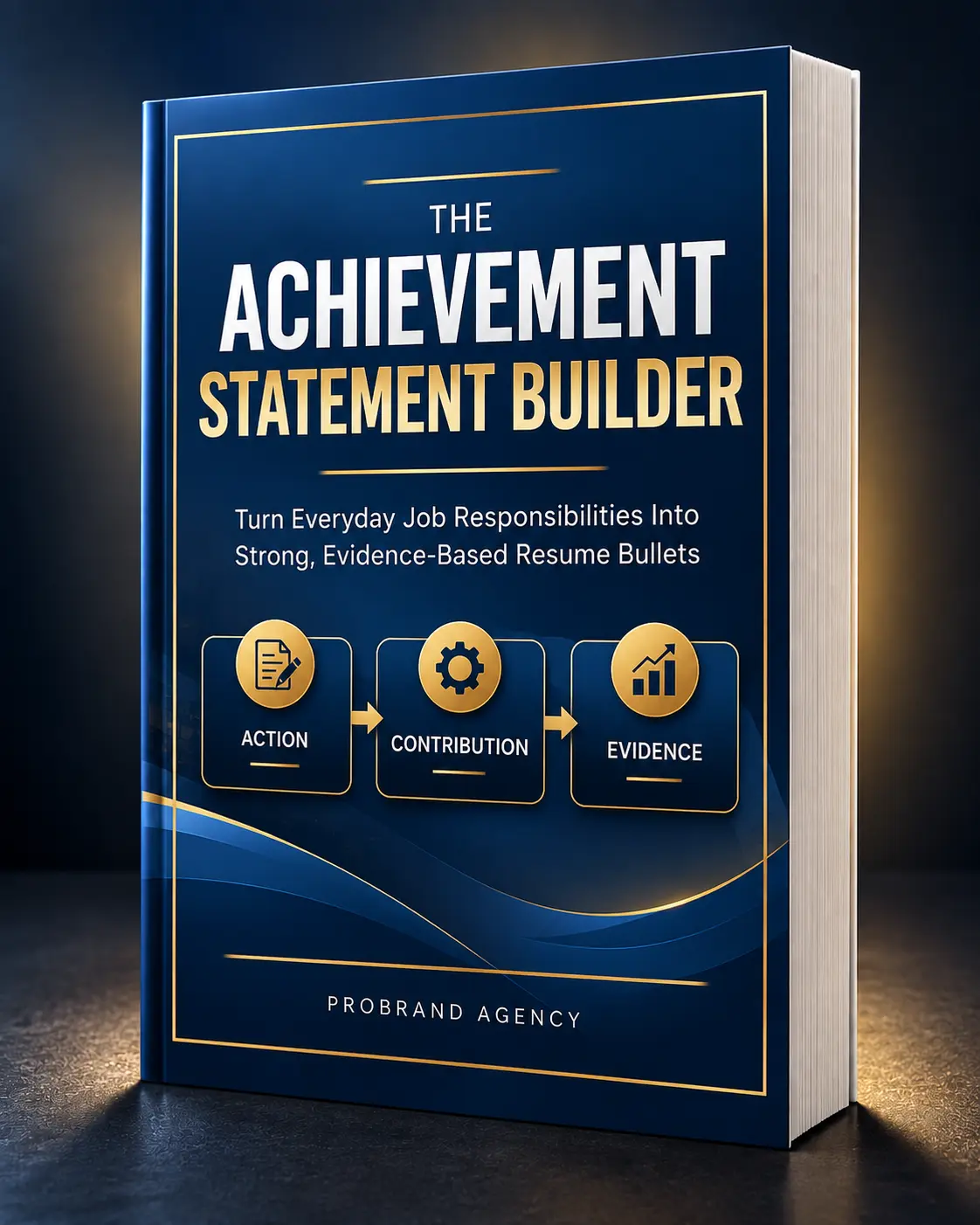
Turn Everyday Job Responsibilities Into Strong, Evidence-Based Resume Bullets
Much of your best material is hiding inside ordinary responsibilities. This builder gives you a simple structure for turning each one into a statement that shows what you did, why it mattered, and what supports it.
No measurable result? Evidence can also be scope, scale, setting, a specific example, or recognition you received. The Builder helps you find what's true and leave out what isn't.
Truth comes first. The Builder never asks you to invent metrics, achievements, titles, skills, or percentages.
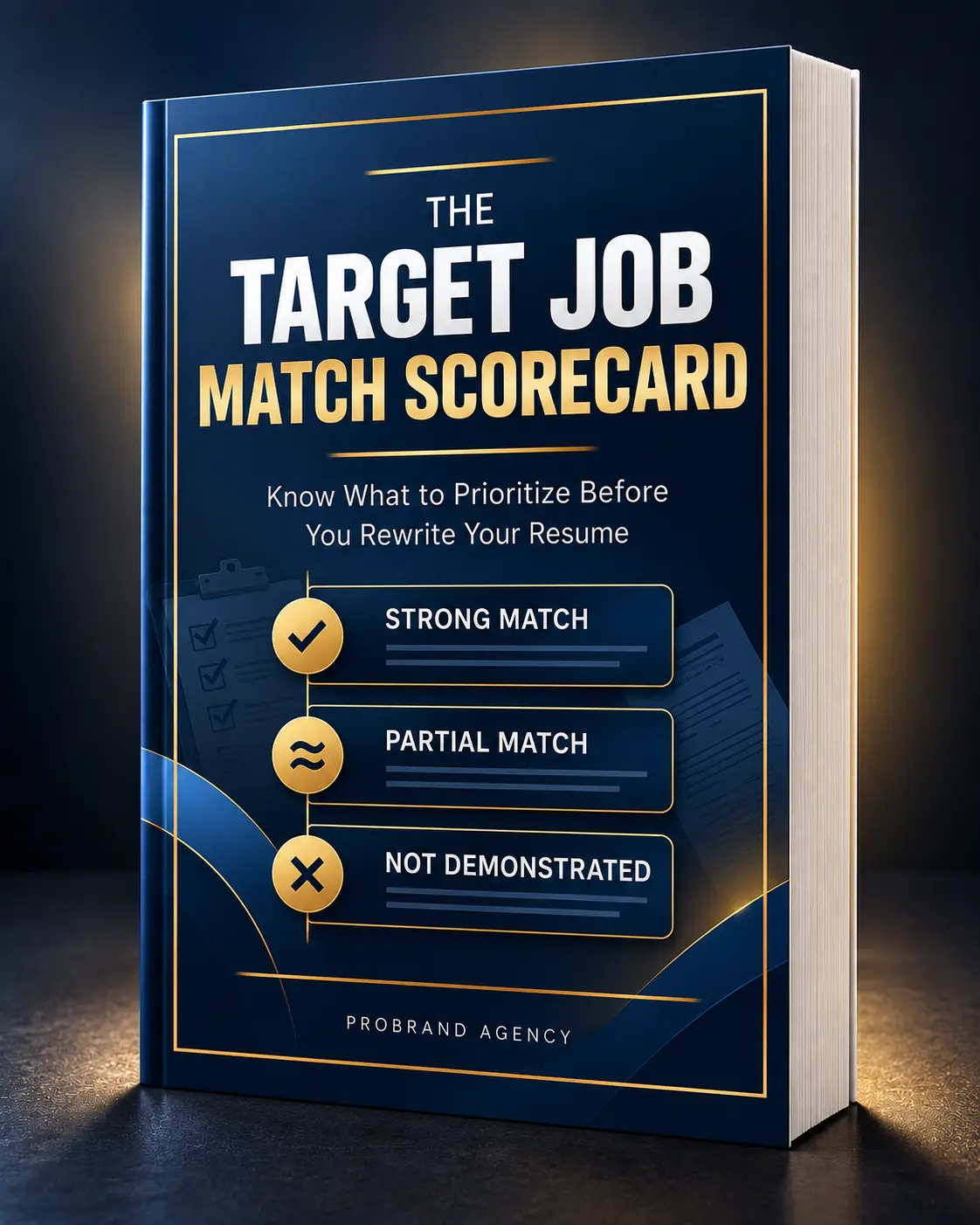
Know What to Prioritize Before You Rewrite Your Resume
Put a real job description next to your actual experience and sort what you find. The Scorecard helps you decide where to focus your effort before you start rewriting.
Your experience clearly connects to an important requirement. Make it easy to see.
There's a real connection, but it needs clearer wording or stronger support.
Your resume doesn't show this one right now. Don't stretch to cover it.
The goal is prioritization, not a perfect score. The Scorecard isn't built to manufacture a flawless match. It helps you see where your real strengths are, so your effort goes where it counts.
Everything you get
The Blueprint and its two bonuses aren't separate downloads. They're designed to work together, one stage at a time.
The Blueprint walks you through all three stages from start to finish. The bonuses give individual stages a dedicated working tool.
The complete guide and workbook: an introduction and eight chapters, with exercises for diagnosis, matching, rewriting, evidence, and review, ending in your action plan.
A structured way to turn everyday responsibilities into clear, evidence-based resume bullets.
A simple way to compare a real job description with your real experience and decide what to prioritize.
You can, and some of it is good. What's harder to find is a clear sequence that takes you from your own generic resume to a role-specific one, with decisions at each step. That's what you're paying for here: a method and a structure, not a pile of tips.
Good. You'll start with it. The Blueprint begins by looking at what your current resume communicates, then shows you how to reshape what's already there for a specific job.
That's exactly what the Match stage is for. You analyze one real job description, identify its most important requirements, and let those guide what you put first.
Most people don't, and you shouldn't make them up. Evidence can also be scope, scale, context, a clear example, or recognition. The Prove stage shows you how to find what's true and use it well.
Editing without a clear target can feel like going in circles. The difference here is that every change is tied to a specific job and a specific decision, so you're not just rewording at random.
Not necessarily. Part of the process is deciding what to keep, emphasize, reduce, reposition, strengthen, or remove. Often the biggest changes are at the top of your resume and in how your most relevant experience is framed.
No. Nothing can honestly promise that.
The Blueprint is designed to improve the clarity, relevance, organization, targeting, and evidence in your resume, so employers can more easily understand why your experience fits a role. But hiring decisions depend on many factors outside your resume, including the number of applicants, timing, internal candidates, budgets, and each employer's own priorities. What this gives you is a stronger, clearer application and a method you can rely on.
Get started
Start with one real job, work through the method, and finish with a focused resume and a process you can use again.
Your price
39
USD
You get The Interview-Ready Resume Blueprint, a guide and workbook with an introduction and eight chapters, plus two bonus tools: The Achievement Statement Builder and The Target Job Match Scorecard. It's a digital product, so nothing is shipped.
It's written for experienced professionals, generally with several years of work history, who are actively applying for jobs and want their resume to communicate their relevant experience more clearly.
No. The Blueprint teaches you how to make the decisions yourself, using your own real experience. That's what lets you repeat the process for future roles.
No. Work through the full system for one real target job first. After that, you can use the same process, in whatever depth fits, whenever you want to tailor a resume for another role.
You're not expected to have them, and the Blueprint never asks you to invent them. It shows you how to use other truthful evidence, such as scope, scale, context, examples, and recognition.
The method starts from a real job description and your real background, so you apply it to the roles you're actually pursuing. It's a process for decision-making, not a set of phrases tied to one field.
No guarantee is made. The Blueprint is designed to improve your resume's clarity, relevance, organization, targeting, and evidence. Hiring decisions depend on many factors outside the resume.
The Blueprint comes with a 30-day money-back guarantee. If it isn't right for you, ask for a refund within 30 days of purchase and you'll get your money back.
[INSERT VERIFIED CREATOR INFORMATION]
The Interview-Ready Resume Blueprint is an educational resource. It's designed to help you present your own real experience more clearly. It doesn't guarantee interviews, job offers, promotions, salary increases, or any other employment outcome.
Hiring decisions depend on many factors outside your resume and outside anyone's control. Examples shown on this page are illustrative only. You're responsible for making sure everything on your resume is accurate and truthful.
You already have the experience. This is a way to make it easier to understand.
Match what the employer needs. Rewrite it clearly. Prove it truthfully.